
Contrary to Conventional Wisdom, Soil Forms Quickly, When You Treat the Land Right
The measure of good soil is "soil organic matter," which can accumulate to optimal levels in 10-20 years, if you organize to optimize plants and rainfall

On Substack, in this article, Life After Death: The Hidden Ecosystems Growing on Old Snags, Lyle Lewis writes:
“When a large tree dies standing, its top eventually fractures or softens. Organic matter accumulates. Fungi move in. Moss establishes. Over time, decayed wood becomes substrate — not just habitat, but soil.”
Have you noticed how soil forms? Where does soil come from? The dirt under our feet? Does soil come from weathered rocks?
I would argue that soil comes primarily from plants, water, dust and debris.
I have noticed how soil forms in the crack of a sidewalk. Water flows into the crack. Seeds follow. Plants grow from seeds. The plant catches dust, debris, fungal spores and more seeds.
Here is an example from Louisville, Kentucky.
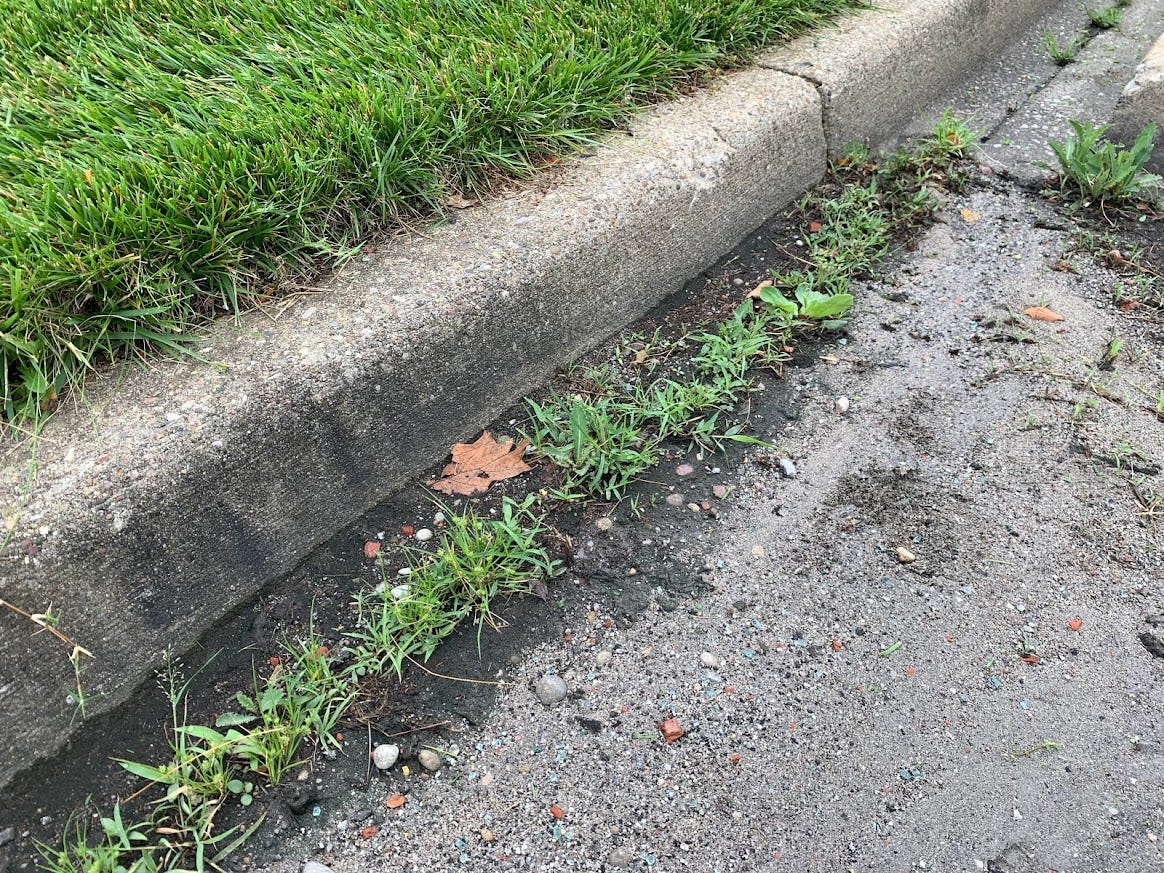
Water and some dirt flowed toward a crack in the pavement. Grass and weed seeds floated in and sprouted. If this process were allowed to continue, you would have several inches of soil in a few years.
Contrast this observation with the conventional wisdom ...
Why Soil Takes Hundreds of Years to Form and Minutes to Destroy: Soil Formation vs. Erosion
“Even under ideal conditions, building one inch of fertile topsoil can take hundreds of years. In harsher climates or nutrient-poor regions, soil formation may take far longer. This slow pace explains why soil is considered a non-renewable resource on human timescales.”
Now, this sounds bleak.
But soil formation can occur in a short time if you practice Gabe Brown’s Five Principles of Soil Health
Farmers like Gabe Brown of North Dakota and Will Harris of Georgia talk about growing the soil organic matter by 4-5% over the course of less than 20 years. That means going from poor soil to great soil.
The “secret” ingredients are plants, water, time and the Five Principles of Soil Health.
Gabe’s Five Principles are as follows:
Avoid disturbance. This includes physical disturbance like tillage and chemical disturbance like chemical fertilizers and toxic pesticides.
Armor the soil surface. This means use mulch wherever plants are not covering the ground. I like wood chips in my residential garden.
Living roots in the ground. You should have plants growing everywhere. No bare soil.
Build diversity. This starts with a diverse plant community. No monocultures.
Incorporate animals. This is mainly for farmers who have livestock. For the rest of us, the call to action is to try not to eradicate all the animals from your home garden, because they have a valuable role.
The moral of the story is that we can grow good soil everywhere. The world’s topsoil is disappearing. That’s true. But that’s mainly because we are neglecting the land. If we practice the principles of soil health, we can grow soil quickly in our farms, forests and landscapes.
If you would like to continue this conversation, please join me for this upcoming webinar, on Zoom:
How & Why to Build Healthy Soil -- Friday, July 24 @ 3:00 - 4:30 PM (Eastern Time)
Soil is a mixture of minerals, organic matter, living organisms, water and air. The minerals (about 50 per cent of soil) are particles of weathered rock, which include tiny grains of clay and silt as well as larger sand particles. The living organisms include fungi, bacteria and insects, and the organic matter incorporates dead plants and microbes, plus other animals in various stages of decomposition. The final product of decomposition is a dark, organic material called humus, which contains relatively high amounts of nitrogen – a nutrient that’s vital to plant health. So yes soil is largely weathered rock!