
How to Reverse the Massive Worldwide Loss of Soil Moisture, and Why …
What really causes the soil to lose its lifeblood (its moisture)? And why are highly qualified scientists pretending not to understand?

Issues addressed herein:
What did we talk about in our Friday, November 14 webinar, and why should you care?
How much water have the soils of the world lost in this century, and why?
How can you and I easily understand the reason for the loss of soil moisture?
How the principles of soil health are at work everywhere, in our farms, forests and landscapes
How to build diversity in the soil, and why
How does healthy soil hold water?
What critters come to live in the soil when we refrain from tillage, and when we build diversity?
What public policies are at war with our soil?
Why do scientists pretend not to understand the mechanisms behind the loss of soil moisture?
What we talked about in Friday’s webinar
On Friday, November 14, we discussed the Worldwide Loss of Soil Moisture. Here is the video, if you care to view it.
Worldwide Loss of Soil Moisture 11-14-25.mp4
To me, this should be one of the biggest stories of the year. In March, the journal Science reported a comprehensive study on the worldwide loss of soil moisture.
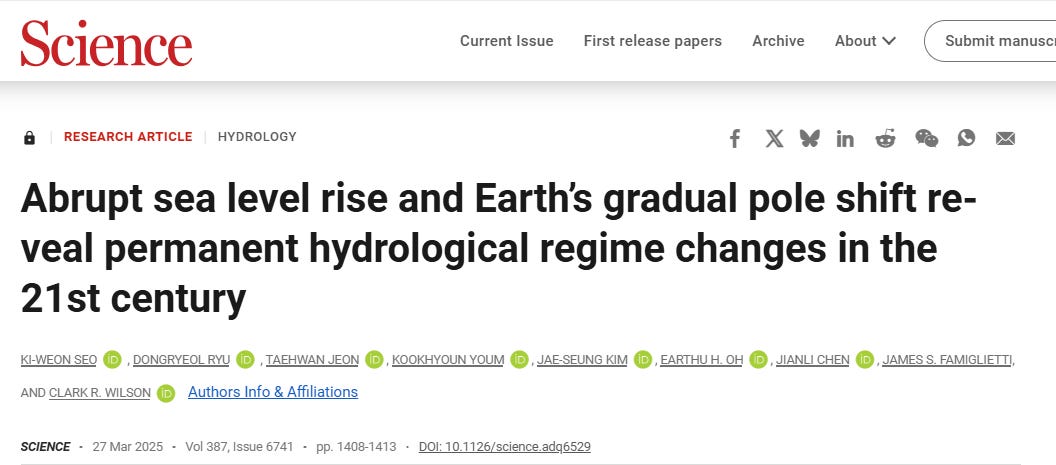
Link to article: Abrupt sea level rise and Earth’s gradual pole shift reveal permanent hydrological regime changes in the 21st century | Science
They reported a loss of 2,623 billion tons of soil moisture worldwide between the year 2,000 and 2,016, for an average annual loss of 150 billion tons of water per year.
That’s a lot of water.
150 giant cubes of freshwater lost every year
One metric ton of water is one cubic meter. One billion metric tons of water is one cubic kilometer. (A kilometer is about ⅔ of a mile.)
Imagine looking out your window and seeing a gigantic cube of water that is one kilometer by one kilometer by one kilometer.
That’s a lot of water.
The world has lost 150 of those giant cubes of water every year, on average, since the year 2,000.
“But, Hart, the oceans of the world have a lot of water, so what’s the big deal?”
Response: The oceans don’t have freshwater, only salt water. You and I cannot drink salt water, and neither can the land-based plants, critters or ecosystems.
Freshwater is flowing into the saltwater and not coming back. Not all of it, but some of it every year is not returning to the land.
How does water cycle from freshwater to saltwater and back?
Every year, salt water evaporates from the oceans, forms clouds and rains and produces rain. This is how saltwater becomes freshwater. And then that freshwater flows into the rivers and oceans, but hopefully not too fast. We want the freshwater to linger as long as possible in the soil and in the plants before it flows into the rivers.
There’s the rub. The rainwater washes too quickly into the streams and rivers, because the soil has lost its natural ability to soak up the rainfall. We have degraded the soil and compacted the soil and deprived it of its natural sponge-like ability to hold water.
We could stop there. The rest is details.
Freshwater falling toward zero
This is why we are losing on average 150 cubic kilometers of freshwater every year. And that’s why the amount of freshwater in the world is falling toward zero. I’m not saying it is close to zero, but it is moving in that direction.
All land-based life forms need freshwater
The freshwater of the world is only 2-3% of all water. It’s a small fraction. It’s precious. We need it. In order to thrive, we and the plants and the trees and the critters of the world need an abundant supply of freshwater. We need it close to where we live, so that it will be there when we need it.
If you want to see death, look at the sands of the Sahara. There is life in and around the Sahara. But nothing lives where water is absent. Unfortunately, we are moving in that same direction worldwide because of a process called desertification. But that’s another conversation.
Why is this happening?
The scientist-authors the study cited above cannot figure out why this is happening. Or at least, they misunderstand why this is happening.
How could they find out? Both the scientific literature and regenerative farmers could tell them that the soils of the world are losing water because they are losing soil organic matter.
Soil organic matter
Soil organic matter is a complex system of organic molecules that together act as a sponge, soaking up rainfall and holding onto it.
We get soil organic matter when we practice the Five Principles of Soil Health, as set forth by Gabe Brown in his bestselling agricultural book Dirt to Soil, One Family’s Journey into Regenerative Agriculture.
The Five Principles of Soil Health
The Five Principles of Soil Health include Principle #1: Minimize disturbance. Whenever possible, refrain from disturbing the soil physically with tillage or chemically with chemical fertilizers. And yet, we disturb the soil systematically and on a large scale, and we subsidize this with our tax dollars and require large scale soil disturbance in order for farmers to get bank loans to plant their crops.
Also, there’s Principle #4, Build diversity. Building diversity means building diverse ecosystems, including the bacteria, fungi, protozoa and nematodes that constitute a thriving soil food web. The way you build this diversity below ground is to build diversity above ground, with a diverse plant community.
The opposite of diversity is a monoculture, which is a plant community dominated by one plant species, e.g., a field of corn.
Monocultures on our farms
As a society, we strongly encourage our farmers to plant monocultures by discouraging cover crops. Farmers are economically incentivized to avoid cover crops under the rules that govern federally subsidized crop insurance, which most farmers get, because it guarantees their income in the event of crop failure. They don’t have to worry about going out of business in that one bad year. That gives them a sense of security. But we pay for it.
Monocultures in our landscapes
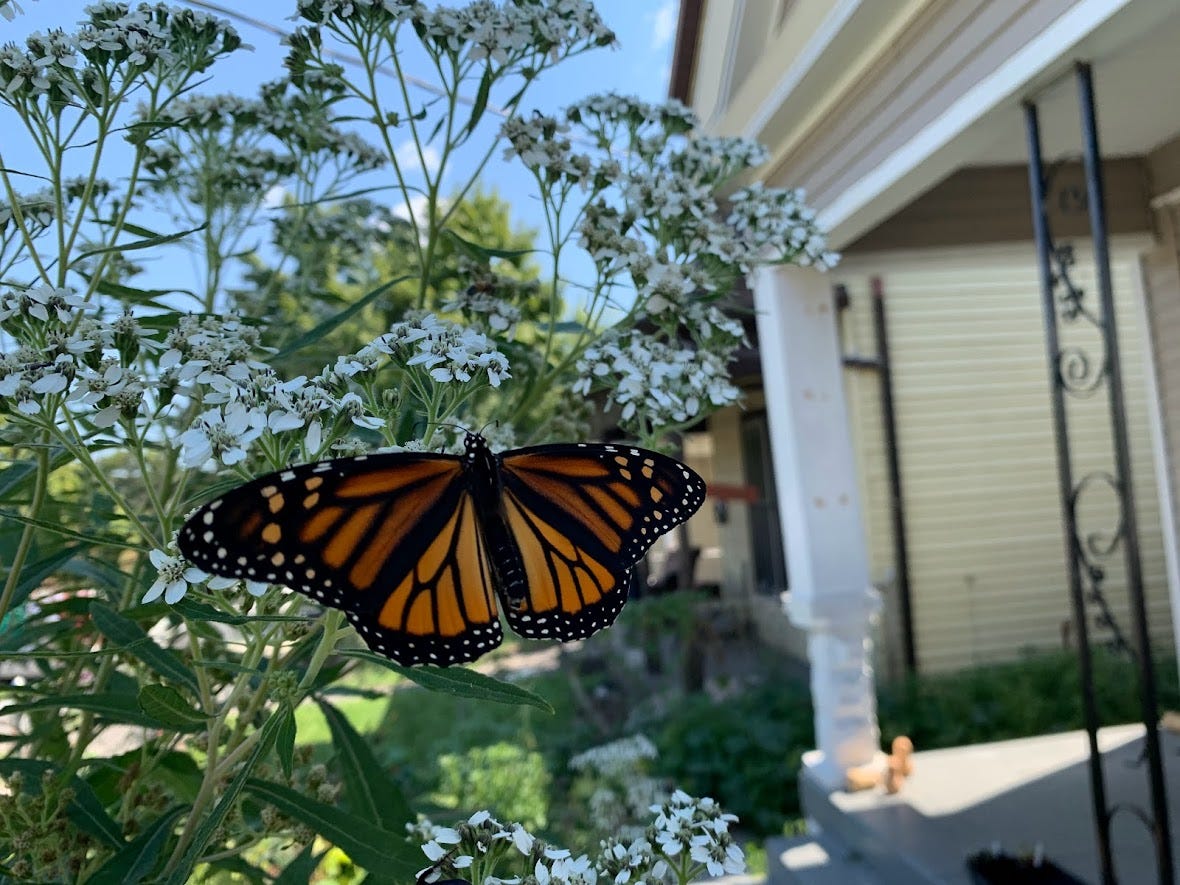
We encourage monocultures in our landscapes when we penalize homeowners for allowing “weeds” to grow, including milkweed, Joe Pye weed, jewelweed, ironweed and frostweed, all of which are valuable for bees and butterflies and all of which you can find in my front yard.
Monocultures in forestry
We encourage monocultures in forestry when we allow timber companies to harvest timber from biologically diverse mature forests and old forests and replace them with monocultures of pine. Governments and companies get greenwash their image with “treeplanting.” But they are planting monocultures.
The moral of the story is that in our farms, forests and landscapes, we strongly encourage monocultures, which runs counter to Soil Health Principle #4, Build diversity.
Building diversity below ground
When we do build diversity above ground, we end up with diversity below ground in the form of a thriving soil food web.
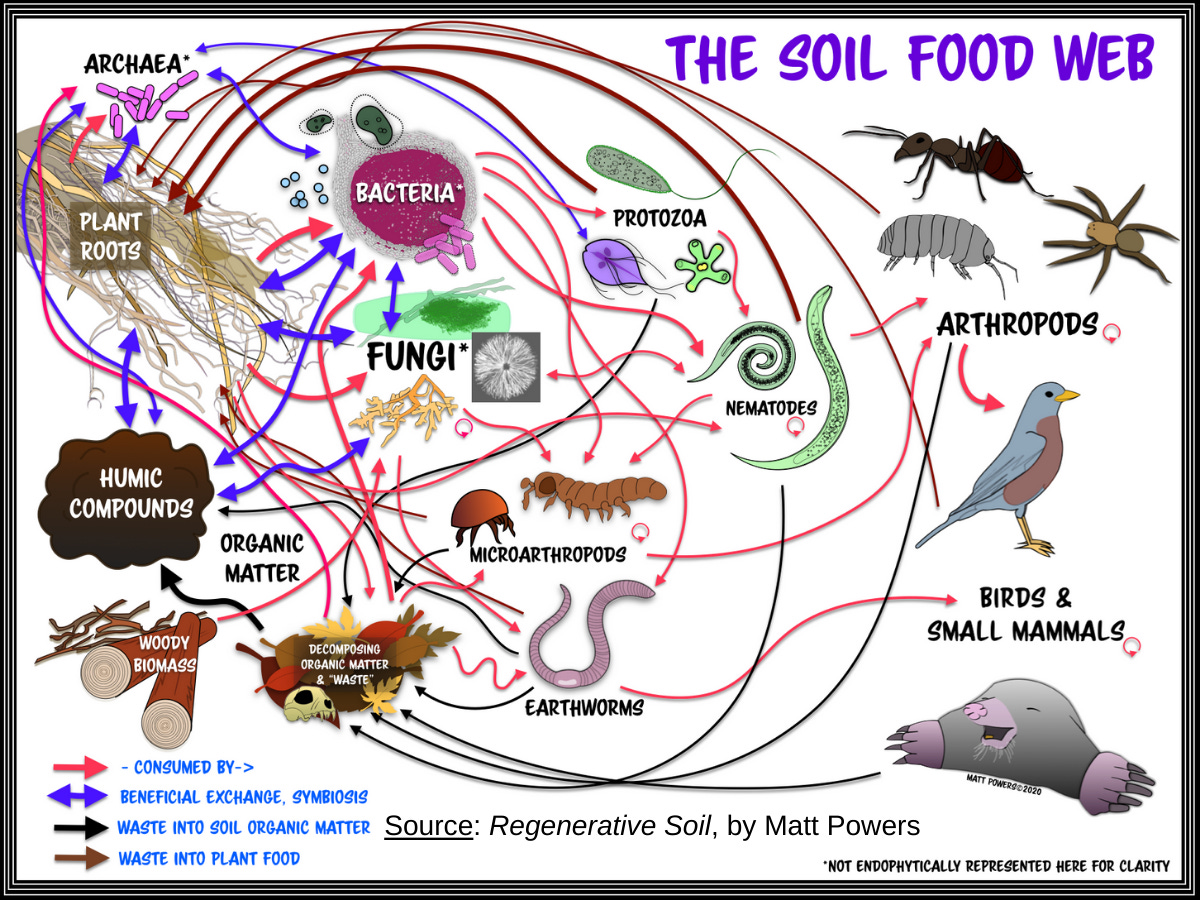
This is the Soil Food Web, a graphic illustration by Matt Powers, author of Regenerative Soil.
The soil food web defines healthy soil. Healthy soil features a thriving, diverse soil food web, including bacteria, protozoa, fungi, nematodes and microarthropods (think tiny insects, spiders and other “arthropods”), which make tunnels and “pore spaces” in the soil. These pore spaces or empty spaces serve to soak up rainfall and hold onto it.
The soil food web also builds “soil organic matter,” a spongy material that turns the soil into a sponge, soaking up rainfall.
And that’s just what we need, isn’t it? Isn’t spongy soil exactly what we need in order to reverse the worldwide loss of soil moisture?
Soaking up the rainfall
What does it take for the soil to capture rainfall and hold onto it?
If we could get our fellow earthlings to implement solutions at ANY FREAKING SCALE, then we could reverse this monumental and colossal loss of soil moisture.
Sadly, the scientists who authored the paper can give us data and measurements, but are oblivious to the source of the problem or the solutions, though it is easy to find solutions in the scientific literature and in the world of regenerative farming.
Why don’t they get to the root of the problem?
If the scientists who wrote this paper were to reveal the source of the problem, they would have to expose the industries of the world that are doing the most to degrade the land, including agribusiness, real estate development, timber and the military industrial complex. Those are powerful adversaries, and taking them on is not the job of those scientists. Their real job is to go with the flow. Their real job is to not make waves.
So what they did was to stick with safe topics, such as climate change, and safe targets, such as fossil fuel companies. What they did was to stick with a safe narrative that says that “climate change” due to “greenhouse gases” is THE existential threat of our generation, bar none.
It’s not important that this be true, only that it be safe.
****
Click here to register for my Newsletter, with updates, commentary, valuable resources and timely information about current events, our climate and our natural world.